Rosa Roth · 19 October 2026
How Navigation Redesigns Influence Search Engine Discovery Sequences in Content Heavy Sites
Content-heavy sites rely on navigation systems to guide both users and automated crawlers through extensive page collections, and redesigns in these systems can shift the order and priority of page discovery by search engines. Researchers have documented how menu structures, internal link hierarchies, and breadcrumb trails determine crawl sequences, particularly when sites contain thousands of articles, product listings, or archived materials that compete for indexing attention.
Mechanisms of Discovery Sequence Changes
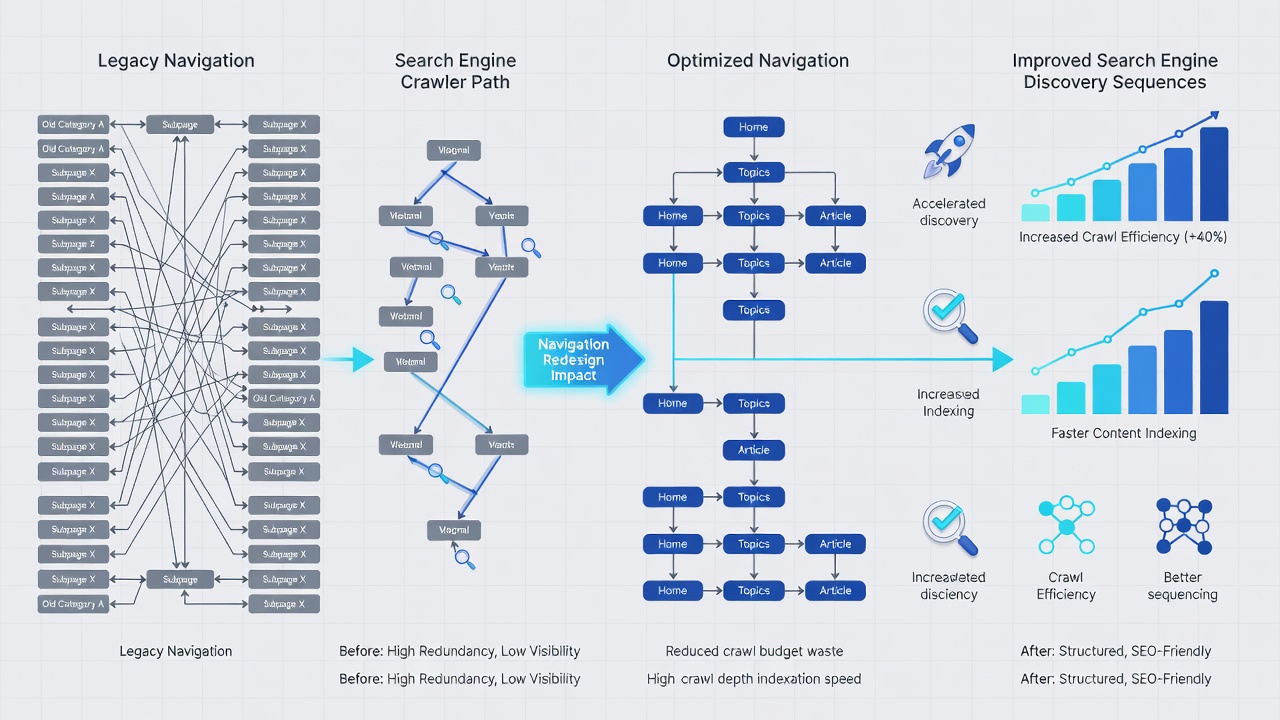
Search engine crawlers follow internal links to build an understanding of site topology, and navigation redesigns alter those pathways by consolidating or expanding link visibility. When primary menus move from top-level horizontal bars to sidebar accordions, for instance, certain category pages receive fewer direct links from the homepage, which delays their appearance in discovery queues. Data from large-scale web crawl analyses indicate that such adjustments redistribute crawl budget allocation across deep content layers, with some sections surfacing earlier while others wait longer for subsequent visits.
Those who monitor indexing patterns note that JavaScript-driven navigation elements often introduce additional steps before content becomes accessible to crawlers. In October 2026, several content platforms reported measurable shifts in crawl frequency after adopting single-page application frameworks for their main menus, because the new structures required separate rendering passes before secondary links entered the discovery sequence.
Effects on Content-Heavy Architectures
Sites publishing daily updates across multiple categories experience pronounced effects when navigation paths change, since each redesign can reorder the sequence in which fresh material reaches indexing systems. Observers have tracked cases where moving archive links from footer sections into expandable mega-menus increased the time between publication and first crawl by several days for older entries, while newer posts gained faster visibility through updated homepage connections.
Studies conducted by academic teams at institutions across North America and Europe reveal consistent patterns: navigation simplification tends to concentrate crawler attention on top-level hub pages, whereas additions of contextual filters and related-content modules extend discovery sequences deeper into long-tail archives. One analysis of university-hosted research repositories showed that breadcrumb enhancements after a 2025 redesign allowed crawlers to reach individual paper pages in fewer hops, improving the overall sequencing of related document clusters.
Technical Factors and Crawl Prioritization
Internal linking density plays a central role because navigation redesigns frequently modify how many links point toward specific content groups. When designers replace broad category links with personalized recommendation carousels, the resulting structure can reduce the number of static pathways available to crawlers on any single visit. Evidence from industry reports indicates that sites maintaining consistent XML sitemap alignment with visible navigation menus experience smoother transitions during redesigns, whereas mismatches create temporary gaps in discovery sequences.
URL parameter handling also intersects with navigation changes, since filter-based menus often generate dynamic URLs that crawlers must evaluate before deciding whether to follow them further. Research published through arXiv examined how parameter normalization after navigation updates affected the order in which product variants appeared in crawl logs for e-commerce archives exceeding 100,000 pages.
Observed Patterns Across Site Types
News portals and documentation libraries provide clear illustrations of sequence shifts following navigation work. When a major documentation platform reorganized its left-hand navigation tree in early 2026, crawlers began indexing newly promoted tutorial sections ahead of legacy reference pages that had previously occupied prominent menu positions. Similar adjustments at multimedia archives in Australia produced comparable results, with video landing pages advancing in discovery order once they received direct links from updated category hubs.
Those tracking long-term indexing metrics note that gradual navigation rollouts, rather than abrupt replacements, allow search engines to maintain parallel discovery paths during transition periods, minimizing disruptions to established sequences.
Conclusion
Navigation redesigns reshape search engine discovery sequences in content-heavy sites by altering link hierarchies, crawl pathways, and prioritization signals that determine indexing order. Data collected across multiple platforms demonstrate that menu placement, JavaScript implementation, and alignment with supporting files such as sitemaps all contribute to the resulting sequence changes. Observers continue to monitor these interactions as sites evolve their structures to balance user experience with efficient content accessibility for automated systems.